
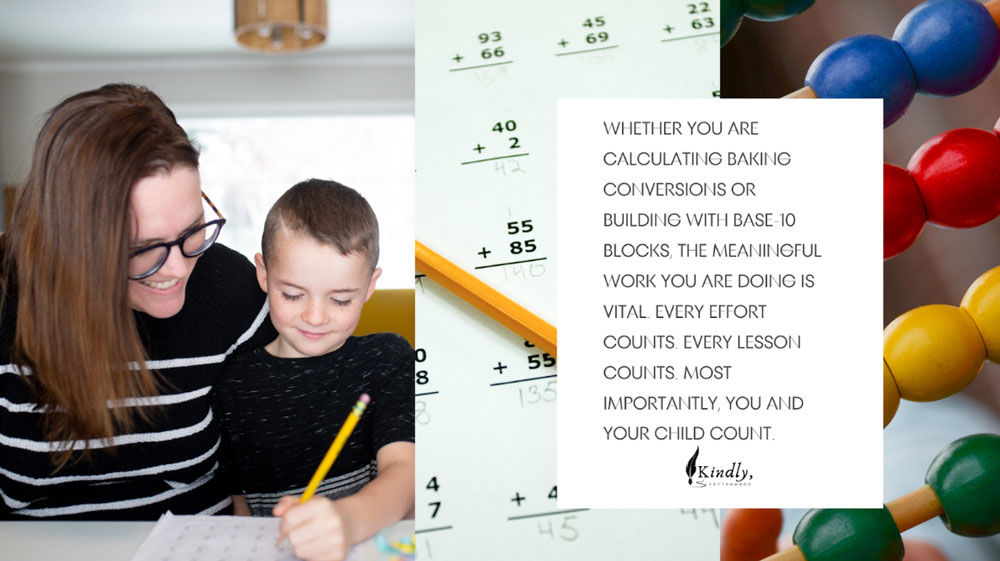
As we lean into a fresh semester, our schoolwide theme, Everybody Counts, continues to inspire conversations about what it means to support confident math learning at home. Math is more than just numbers; it’s a foundation for critical thinking, perseverance, and self-belief.
If we’re honest with ourselves, math is either something you feel confident about in the homeschool setting, or you really, really don’t. But here’s the truth: you don’t have to have it all figured out to support your child’s math growth. And it’s never too late to build momentum for yourself as the homeschool parent or for your student.
This month, we invited a few exceptional in-house experts to speak to the homeschool parent experience when it comes to math. Their perspectives, grounded in both professional practice and personal experience, offer encouragement, practical advice, and a reminder that you are not doing this alone.
Shannon Carpenter: Home Educator, HST & Educational Design Expert
Dr. Shannon Carpenter has worn many hats: homeschool parent to seven children, HST, and now a Lead Educational Design Expert for our Unit Studies program. Her experience spans seasons of high structure and freeform exploration, and she reminds us that math success in homeschool doesn’t look the same for every family.
Here’s what Shannon wants you to know:
Progress, not perfection.
It’s okay for your child to make mistakes—that’s how learning happens. Homeschooling gives you the flexibility to adjust in real time and provide immediate feedback. It’s not about getting every problem right; it’s about the growth and confidence that come with persistence and support.
Math doesn’t have to be one-size-fits-all.
It’s okay if your approach to math changes over time. Shannon shares:
“Some seasons of homeschooling, we relied heavily on online curriculum with video instruction and auto-grading—very hands-off and consistent. Other years, we explored math through stories, nature, or hands-on discovery. One year, we used Waldorf-inspired lessons outdoors with sticks, leaves, and stones. Another year, we learned through a Charlotte Mason-style story that wove math into a family’s life on a farm. There are so many ways to learn.”
Consistency matters.
Children thrive when math is part of their regular rhythm. That doesn’t always mean long lessons or pressure to master every concept overnight—it means showing up, staying engaged, and finding the right pace for your child’s season of life.
You’ve got this, and we’re here to help.
Whether you’re feeling stuck or just want to explore new ideas, you’re surrounded by a community of HSTs, virtual classes, and support programs designed to come alongside you. Don’t be afraid to ask questions, try something new, or give yourself grace.
Evan Clark: Middle School RISE Math Teacher
Evan Clark is a seasoned educator who teaches middle school math in our RISE program. His perspective comes from working closely with students across a wide range of abilities and confidence levels, and helping them see themselves as capable mathematicians.
Here are Evan’s top insights for homeschool parents:
Be a voice of confidence.
“The number one thing I would tell homeschool parents is this: don’t fear the math.”
Evan notes that when parents carry their own anxiety or doubt into teaching, it can unintentionally transfer to their children. “Approach it with curiosity instead of pressure. Remember that you’re learning too—and that’s powerful modeling.”
Focus on building a relationship with math.
It’s easy to fall into a “check-the-box” mindset, but Evan encourages parents to view math as an evolving process. “There’s so much more to math than just right or wrong answers. Celebrate effort, persistence, and creative problem-solving.”
Utilize your supports.
“You’re not alone,” Evan emphasizes. Between curriculum tools, virtual instruction, and guidance from HSTs and teachers, there are ample resources to help your student thrive. Don’t hesitate to lean on them.
Success takes many forms.
Evan reflects, “Some of my best math students weren’t the ones who got everything right the first time. They were the ones who kept going, asked questions, and began to believe in themselves.”
What’s Next?
We are committed to helping you bring math to life at home by continually providing ideas, resources, and inspiration. There are many ways to engage:
- Connect with Your HST: Reach out to your Homeschool Teacher for tailored resources and suggestions.
- Join Our Events: Look for math-related adventures at select park days and events.
- Utilize the Lending Library: Explore the extensive math section for hands-on materials.
- Use Free Apps: Access educational apps through Clever.
- Consider Enrollment: Explore future enrollment in a Boost or RISE class.
As you continue in this new semester, we hope these words breathe life into your homeschool journey. Math can be meaningful. It can even be fun. And more than anything, it can be a shared adventure that builds confidence in your student and in you.
Whether you are calculating baking conversions or building with base-10 blocks, the meaningful work you are doing is vital. Every effort counts. Every lesson counts. Most importantly, you and your child count.